Saturday, December 05, 2009

More marsh

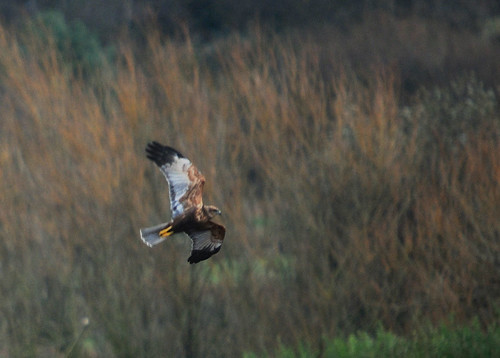
Curiouser and curiouser; the virus(es) on my PC seem to have completely disappeared by themselves. I'm delighted to have my PC working back at normal speed but a little disturbed they did one of their own accord - I think they might be regrouping somewhere on my HD! Anyway it lets me share some marsh harrier shots from last week.
marsh harrier4

Strong winds meant the harrier was able to hover sideways on the gusts giving great views of his underwing patterns before returning to hunting normally.
marsh harrier5

Come summer when the light is good I intend to spend a lot of time somewhere near that mini getting awesome shots of these guys. For now these will have to do.

Friday, December 04, 2009

ugly duckling

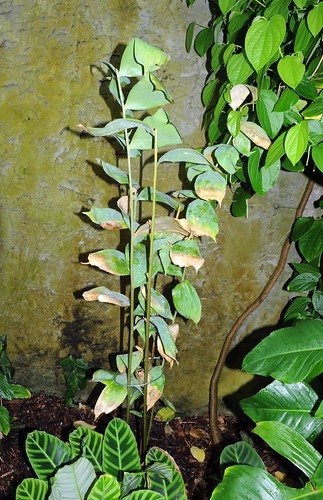
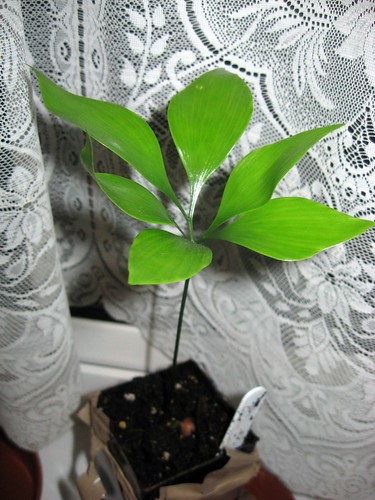
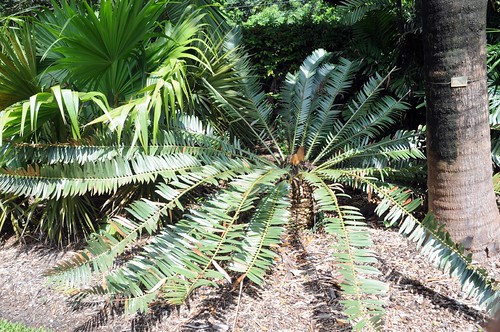
Looking at the plant below, you'd be forgiven for, erm, stopping looking at it rather quickly. Not particularly attractive upright stems, big leaves, some sort of lily post deadheading perhaps? Not at all. This is one of the most sought after of all cycads; Ceratozamia euryphyllidia.

ceratozamia euryphyllidia

When it's not looking as sorry for itself as this one does this one is truly spectacular(and a lot of the other pictures online of the species looking spectacular are of this particular individual which on my day visiting it had obviously had a pruning for some horticultural reason - it'll grow back).

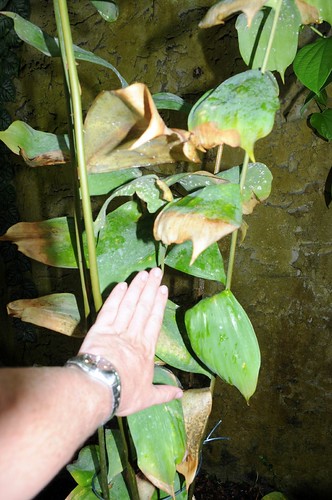
ceratozamia euryphyllidia2
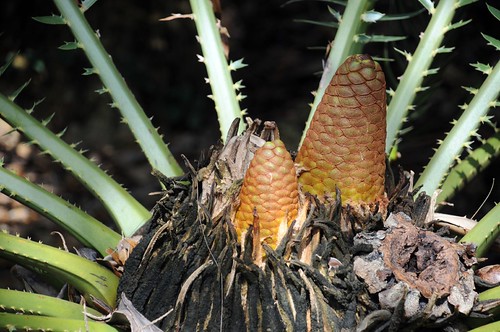
You can sort of see why in the above shot. That is my (as previously discussed average sized for a bloke) hand alongside some gigantic leaflets. Now imagine those arrayed either side of a 10 foot long leaf and you can imagine why this might be a desirable species to have. Unfortunately its yet another highly endangered plant. The wild population located in Veracruz, Mexico, apparently consists (or consisted of) around 30 plants. Whether any still exist I cannot say. There are rumours on the cycad grapevine that a single (shameful) collector now possesses a lot of (perhaps all) the wild specimens having collected from that population. They are not being pollinated and so the species remains critically endangered and rarely seen. In fact the above is the only specimen on public display I know of. Perhaps some day the collected population will get pollinated by someone and seeds will be spread across the world protecting the species. Perhaps not.

Thursday, December 03, 2009

Corn-ucopia of colours

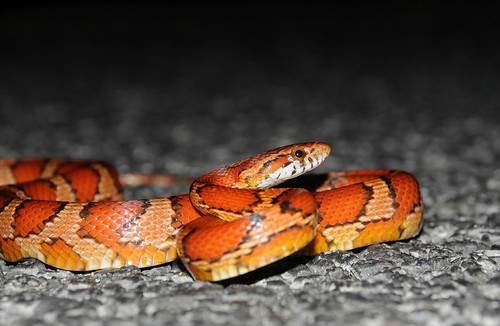
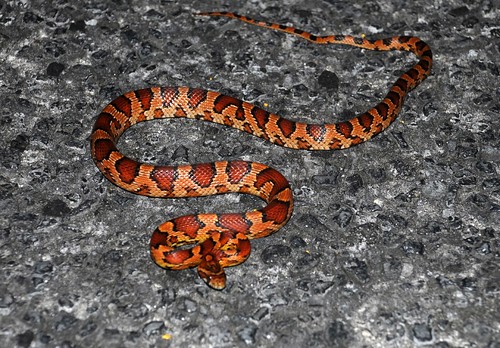
So in the last corn snake post I mentioned Elaphe guttata's spectacular range of colorations and I thought before I forgot it'd be worth doing a comparison post. So here's the one I featured last time again which is just a beautiful specimen:

2nd corn

This is the first one I found (which is why the shots are less good, I was still getting my snake shooting eye in as it were). You can see its much deeper in both the reds and yellows and just generally bolder in its pattering.

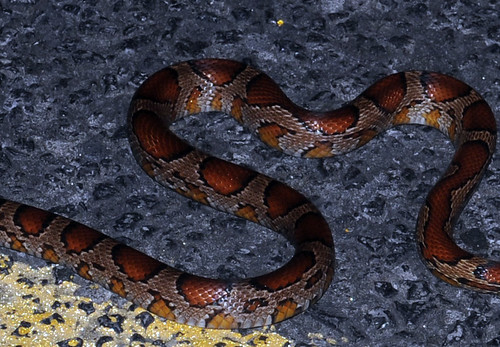
corn

The black margination around the red rosettes is a lot clearer too. I really liked this one and wish I'd got better photos.
corn2

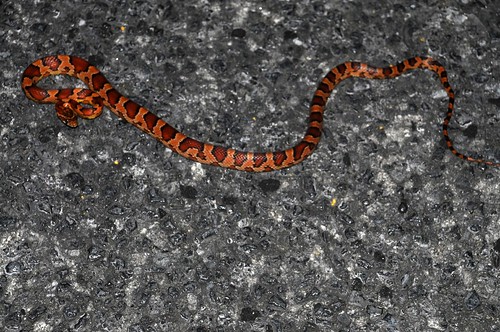
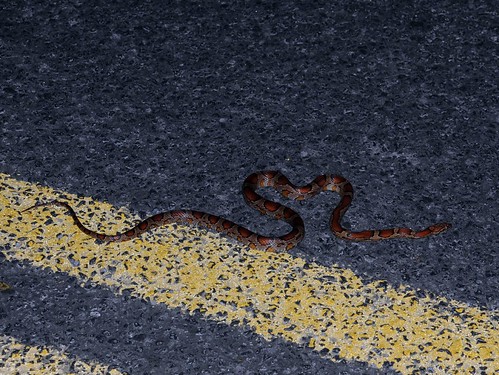
And then this last corn is completely different again. Unfortunately there are no attractive close-ups of this snake either as it was already dead on the road which was a heartbreaker. A really pretty snake and it can only have been hit a few minutes before I came along (when it would have been escorted off the road to safety whilst I took nice photos of it).

corn6

As you can see this snake has no yellow in it but rather a kind of tawny-grey. A completely different look again.

corn6crop

Most regions across the south-eastern USA have their own corn "look" - they vary tremendously even within a small area as this post shows (these were all found within a mile of each other) but tend to have a similar look. Snakes from further north or east than these would look rather different again. Pretty cool eh.

Tuesday, December 01, 2009

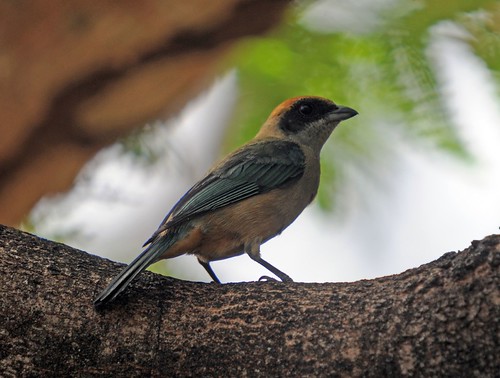
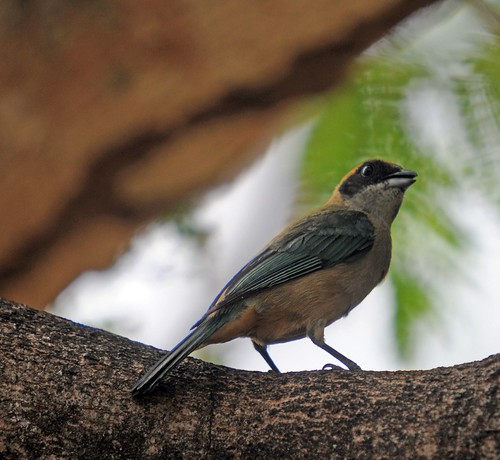
Burnished buff tanager

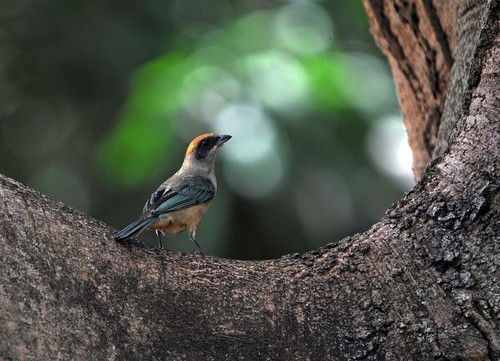
I mentioned a while ago that the neotropical birds' names are brilliant - lengthy descriptions as much as names. This one is a particular goody; burnished buff tanager.

Burnished buff tanager - cayana ssp.

It is a tanager. It buff and the markings do look kind of burnished. It does exactly what it says on the tin.

Burnished buff tanager - cayana ssp.

The wings look almost like they've been fashioned from greening copper, lovely. This was the only one I saw, working its way around the garden at Hato el Cedral. Its an absolute beauty of a songbird and seeing a little flock of these would be fabulous.

Burnished buff tanager - cayana ssp.

I think that's one of the cooler aspects of visiting somewhere new. Its not only the rare stuff but the different common stuff hopping around in gardens and parks. There were many other birds in the gardens of Hato el Cedral plus mammals (3 species), amphibians and reptiles. I know I'm making a bit of a meal of these venezuela posts but think of them as occasional winter warmers. We'll get to them all eventually.

Monday, November 30, 2009

The falls

The 7 waterfalls of Cainama Lagoon as seen from the air. I'm afraid I don't have better shots as I was trying not to throw up and wishing for a quick merciful death if the plane crashed for most of the flypast.

cainama lagoon aerial

Speaking of crashes, my laptop is infected by some assholic faux-virus checker virus which somehow found its way onto my system and which is doing irritating things like preventing me opening things, disabling task manager and redirecting my browser toward porn and viagra commercials. I've stocked the post larder for the next week or two as a result but if things get weird or quiet round here for a bit you now know why. Incidentally if anyone knows the person responsible for "antivirus system pro" (thats the name of the virus and is not an actual virus checker) please punch them on my behalf. Ta.

Friday, November 27, 2009

The odd couple

Its been too long since we had some underwater shots so here we go.

blackjack & ray1

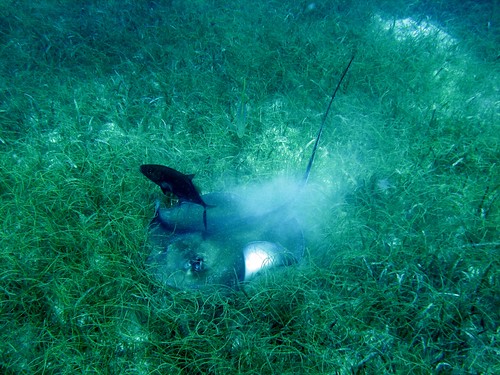
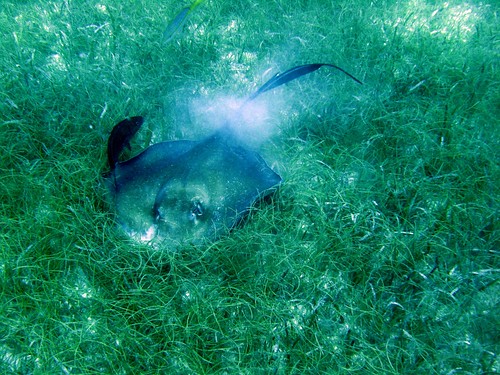
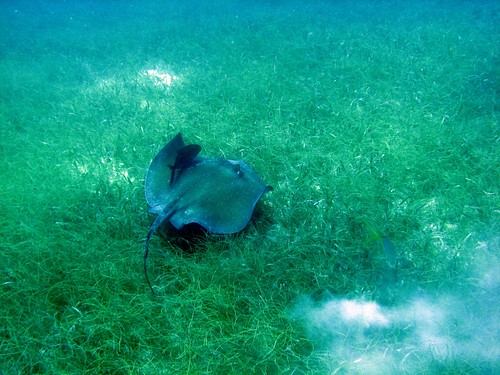
A rather odd couple I think you'll agree. We've obviously got a stingray above, a southern stingray to be precise, along with a buddy. A shadow or wingman if you will. It is a jack species and if I'm perfectly honest I'm not sure which one.

blackjack & ray3

What is going on in these shots is something I saw reasonably frequently. The jack is using the ray to find food. Below you can see the ray stirring up the sand bottom as it feeds on crustaceans, molluscs and what not within the seagrass meadow.

blackjack & ray2

As it does this it will disturb some things it probably won't eat. The grass is full of weird little green fish; wrasses, filefish and small snapper are all found in vast numbers either sheltered amongst or camouflaged as the grass. As the stingray feeds, these will move away and the jack will (try to) speed in and grab them.

blackjack & ray4

By positioning itself above the ray as it has the jack is in prime position to take advantage; he is close to the source of the disturbance (the ray) and can use it as cover from which to surprise prey. I imagine the ray gets very little out of the situation beyond an irritating movement in its peripheral vision and some company.

Thursday, November 26, 2009

The windowsill primeval

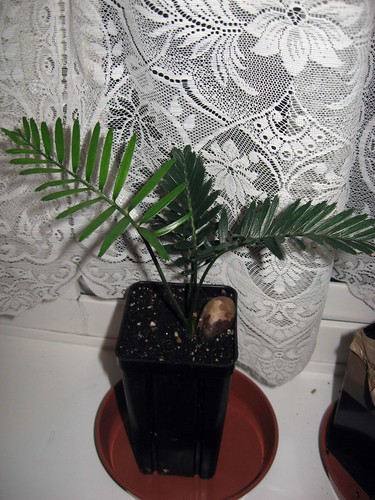
So having just moved to a new island, I'm currently staying in rather cramped temporary accomodation whilst we find a house we want to live in fulltime (I'm pushing hard for something with a garden along the lines of Pure Florida HQ to little success). Nevertheless, I'm not going to starve myself of all the little luxuries in life. One has to have one's pets afterall. So below, sat on my little windowsill is a baby Bowenia spectabilis. This is the sibling species to Bowenia serrulata which we've featured before and is distinguished by its smooth-edged leaflets. It's a truly beautiful species which shares the Daintree rainforest with the giant Lepidozamia hopei as well as cassowaries and all sorts of other goodies.

bowenia spectabilis

That's the entirety of Bowenia and the Stangeriacaea family featured now by the way although there is a form called "tineroo" which is probably part of B. serrulata which I'll feature if I can and there are also 2 fossil species. The little Bowenia isn't alone though:


macrozamia communis

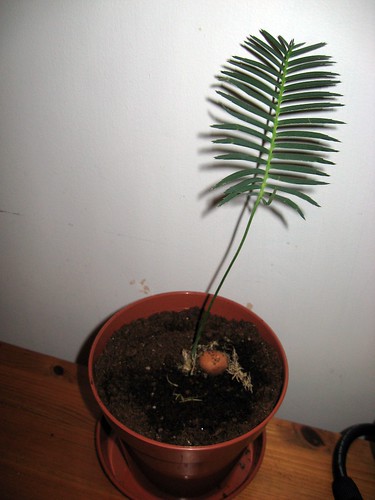
Above is a little Macrozamia communis or burrawang (which I hope will someday grow up to be a big burrawang and below....

dioon angustifolium

...is a little Dioon angustifolium. Someday soon I'll show you what a big one of those looks like (its rather impressive).

Wednesday, November 25, 2009

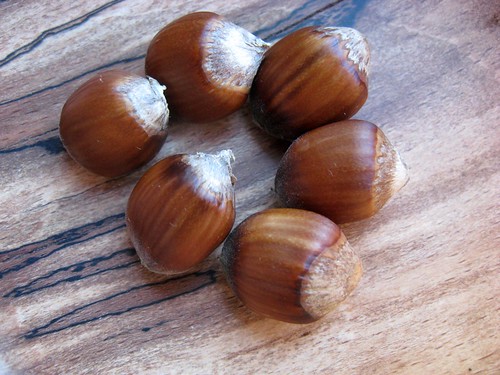
Nearly wordless wednesday - gone nuts

turkish hazels

Remember these when they were on the tree? These are all from Corylus colurna "Te Terra Red" (sat in a bowl made by Papa Haku.).

Tuesday, November 24, 2009

Grip it and ripit....and mipit

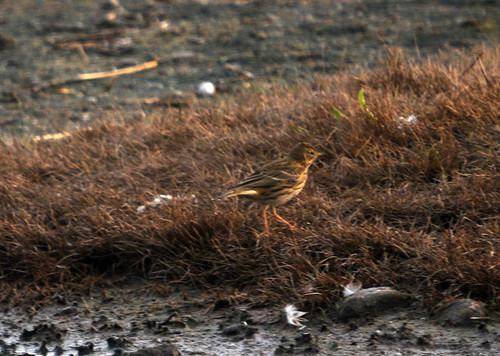
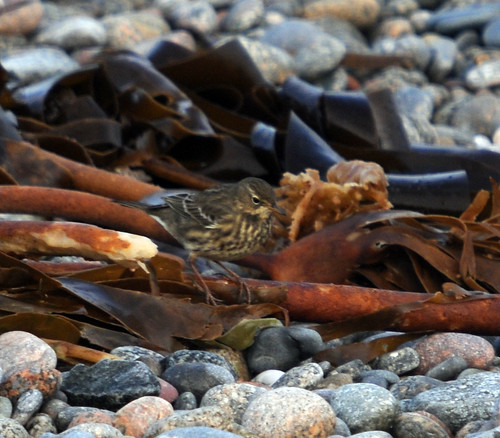
So I'm not the kind of birder who's afraid to ask for id help. In fact I'm more than happy to get someone else's confirmation (or frequently correction) of my id so I'm no stranger to the birdforum id sub-forum. One group of birds in particular is guaranteed to send me running to BF tail twixt legs. Pipits. They're just so brown and streaky. Anyway thanks to birdforum I can tell you that this is a meadow pipit (mipit).

meadow pippit

and this is a rock pipit.

rock pipit

Still looking for water pipit. Probably won't recognise one when I see it.

Monday, November 23, 2009

Tapir! Tapir! Tapir!

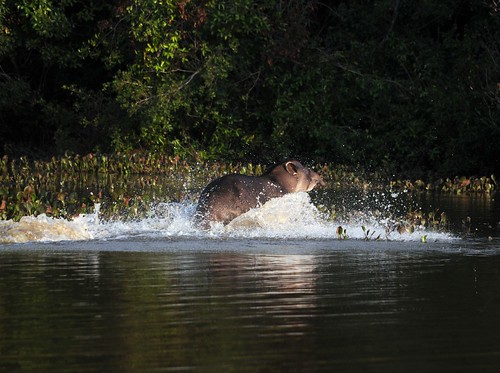
This may have been the highlight of the Venezuela trip so I'll start at the beginning. We were in a boat travelling around the wetlands of Hato el Cedral (which is awesome) and with us handily were three nature guides and the sharp-sighted bus/boat driver (of whom more in later posts), one of the guides was the Hato's own Rafael and two of the guides were there to shoot photos for a field guide. Suffice it to say then we had a boatload of keen-eyed naturewise people and we were bagging up with raptors, herons, sunbittern, reptiles, wild muscovy duck, you name it we were seeing it and getting nice photos to boot when suddenly someone started screaming "tapir! tapir! tapir! go! go! go!"

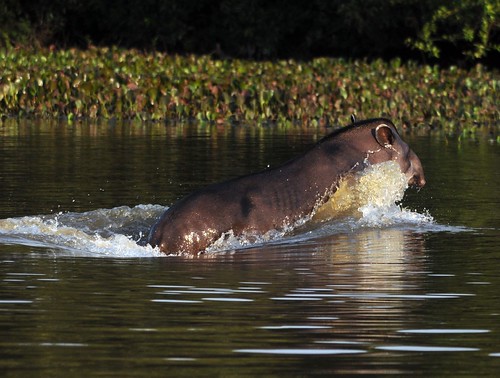
Now for those of you who don't know tapirs are perissodactyls (odd-toed mammals) of which there are only about 17 or so living species. The more famous perissodactyls are the horses and the rhinoceroses and physically tapir fall somewhere between the two. They are also phenomenally difficult to see in the wild (in Venezuela at least). But sure enough amidst the confusion and shouting our driver had spotted the beast crossing the river way in front of us and was speeding towards it, I was at this point on the bow with my finger held down on the shutter of the D300 when.......the beast sounded. Now I wasn't expecting that. It was swimming fairly confidently across the river but I didn't expect it to dive as we came upon it. For a surprisingly long time the mighty beast remained submerged before finally bursting from the water very close to the boat and headed in the opposite direction to before it submerged. Spray went everywhere and we were left in no doubt that this was a big animal. Behold:


tapir4

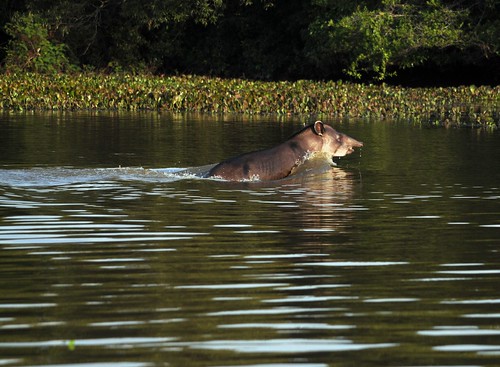
I think you can really see the horse/rhino connection in these shots as well as the immense power of the animal. Just a pure explosion of muscle. As the beast splashed to the other side of the river, a bow wave preceding it. I knew we'd been very very lucky.

tapir2

I didn't realise quite how lucky though. In the last 7 years only 3 tapirs have been seen. One of the guides with us had been guiding the area for 12 years and only seen 3. Everyone was unbelievably jubilant at seeing this weird prehistoric beast. Check out the trunk-like snout too. Unbelievable creature.

tapir1

I think the coolest aspect of the whole experience came that night though. Gathered in the canteen around a laptop we shared our photos with the locals. Most of them have never seen a tapir and were absolutely amazed. Amazed but at the same time tremendously proud they had these fabulous creatures on their ranch. It was awesome.


Saturday, November 21, 2009

The list.....

So here is the new island list. I've been using the excellent Bubo listing website to compile this hence its in taxonomic order rather than sighting order. Links are links to posts about the bird in question.
  1. Greater White-fronted Goose, Anser albifrons
  2. Greylag Goose, Anser anser
  3. Brent Goose, Branta bernicla
  4. Common Shelduck, Tadorna tadorna
  5. Eurasian Wigeon, Anas penelope
  6. Gadwall, Anas streptera
  7. Eurasian Teal, Anas crecca
  8. Northern Mallard, Anas platyrhynchos
  9. Northern Shoveler, Anas clypeata
  10. Common Pochard, Anas ferina
  11. Tufted Duck, Aythya fuligula
  12. Lesser Scaup, Aythya affinis
  13. Common Goldeneye, Bucephala clangula
  14. Common Pheasant, Phasianus colchicus 
  15. Black-throated Diver, Gavia arctica
  16. Great Northern Diver, Gavia immer 
  17. Little Grebe, Tachybaptus ruficollis
  18. Great Crested Grebe, Podiceps cristatus
  19. Northern Fulmar, Fulmarus glacialis
  20. Northern Gannet, Morus bassanus
  21. Great Cormorant, Phalacrocorax carbo
  22. European Shag, Phalacrocorax aristotelis
  23. Great Bittern, Botaurus stellaris*
  24. Little Egret, Egretta garzetta
  25. Grey Heron, Ardea cinerea
  26. Eurasian Spoonbill, Platalea leucorodia
  27. Eurasian Marsh Harrier, Circus aeruginosus
  28. Eurasian Sparrowhawk, Accipiter nisus
  29. Common Buzzard, Buteo buteo
  30. Common Kestrel, Falco tinnunculus
  31. Merlin, Falco columbarius
  32. Peregrine, Falco peregrinus
  33. Water Rail, Rallus aquaticus
  34. Common Moorhen, Gallinula chloropus
  35. Common Coot, Fulica atra
  36. Common crane, Grus grus
  37. Eurasian Oystercatcher, Haematopus ostralegus
  38. Pied Avocet, Recurvirostra avosetta
  39. Ringed Plover, Charadrius hiaticula
  40. European Golden Plover, Pluvialis apricaria
  41. Grey Plover, Pluvialis squatarola
  42. Northern Lapwing, Vanellus vanellus
  43. Sanderling, Calidris alba
  44. Dunlin, Calidris alpina
  45. Common Snipe, Gallinago gallinago
  46. Black-tailed Godwit, Limosa limosa
  47. Bar-tailed Godwit, Limosa lapponica
  48. Whimbrel, Numenius phaeopus
  49. Eurasian Curlew, Numenius arquata
  50. Common Redshank, Tringa totanus
  51. Common Greenshank, Tringa nebularia
  52. Common Sandpiper, Actitis hypoleucos
  53. Ruddy Turnstone, Arenaria interpres
  54. Grey Pharalope, Phalaropus fulicarius
  55. Black-headed Gull, Chroicocephalus ridibundus
  56. Mew Gull, Larus canus
  57. Lesser Black-backed Gull, Larus fuscus
  58. Herring Gull, Larus argentatus
  59. Great Black-backed Gull, Larus marinus
  60. Sandwich tern, Sterna sandevicensis
  61. Common Guillemot, Uria aalge
  62. Razorbill, Alca torda
  63. Atlantic Puffin, Fratecula arctica
  64. Rock Dove, Columba livia
  65. Stock Dove, Columba oenas
  66. Common Wood Pigeon, Columba palumbus
  67. Eurasian Collared Dove, Streptopelia decaocto
  68. Barn Owl, Tyto alba
  69. Snowy Owl, Bubo scandiacus
  70. Long-eared owl, Asio otus
  71. Common Swift, Apus apus
  72. Sky Lark, Alauda arvensis
  73. Sand Martin, Riparia riparia
  74. Barn Swallow, Hirundo rustica
  75. House Martin, Delichon urbicum
  76. Meadow Pipit, Anthus pratensis
  77. Rock Pipit, Anthus petrosus
  78. Yellow Wagtail, Motacilla flava
  79. Grey Wagtail, Motacilla cinerea
  80. Pied Wagtail, Motacilla alba
  81. Winter Wren, Troglodytes troglodytes
  82. Hedge Accentor, Prunella modularis
  83. European Robin, Erithacus rubecula
  84. Black Redstart, Phoenicurus ochruros
  85. Stonechat, Saxicola torquatus
  86. Northern Wheatear, Oenanthe oenanthe
  87. Ring Ouzel, Turdus torquatus
  88. Common Blackbird, Turdus merula
  89. Fieldfare, Turdus pilaris
  90. Song Thrush, Turdus philomelos
  91. Redwing, Turdus iliacus
  92. Mistle Thrush, Turdus viscivorus
  93. Eurasian Reed warbler, Acrocephalus scirpaceus
  94. Common whitethroat, Sylvia communis
  95. Common Chiffchaff, Phylloscopus collybita
  96. Willow warbler, Phylloscopus trochilus
  97. Firecrest, Regulus ignicapilla
  98. Spotted Flycatcher, Muscicapa striata
  99. Long-tailed Tit, Aegithalos caudatus
  100. Blue Tit, Cyanistes caeruleus
  101. Great Tit, Parus major
  102. Short-toed Treecreeper, Certhia brachydactyla
  103. Black-billed Magpie, Pica pica
  104. Eurasian Jackdaw, Corvus monedula
  105. Carrion Crow, Corvus corone
  106. Raven, Corvus corax
  107. Common Starling, Sturnus vulgaris
  108. House Sparrow, Passer domesticus
  109. Chaffinch, Fringilla coelebs
  110. European Greenfinch, Carduelis chloris
  111. European Goldfinch, Carduelis carduelis
  112. Common Linnet, Carduelis cannabina

Birding nonsense

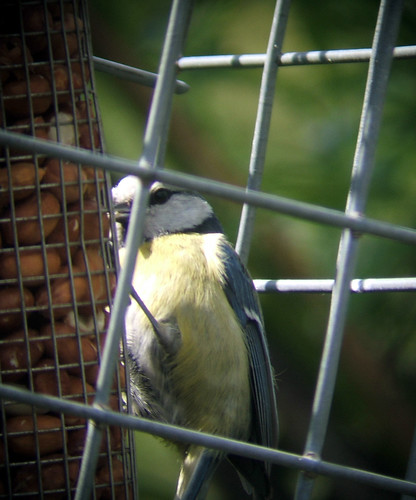
Hmm. So this morning I got up surprisingly early (actually not that early, but considering the week I've had, plenty early) to go look for two lesser scaup that have been reported on island. Now considering that I've now left the caribbean (where scaup were an annual vagrant but one I didn't see which is your first clue to how this part of the story ends) and am back on the British side of the Atlantic this would be a very nice bird to have on my new local list. I didn't see them, or rather I haven't yet - I haven't given up, but it got me thinking about one of the absurdities of patch, regional or year listing. You see I still haven't seen a blue tit here. I have 45 birds on the list but no blue tit.
blue tit
I've seen hundreds of these in the UK - why can't I find one now I want one??

For american birders this is a bit like going to see some freak european vagrant when you haven't yet bagged a chickadee. Its ridiculous. They are supposedly common here but I just can't turn one up at the moment. Nor have I seen hedge accentor (aka dunnock), another super-common bird. I was pretty laid back about it, listing is for fun after all but I'm getting kind of irritated about my inability to find one now. On the one hand I know sooner or later one will cross my path but on the other hand I want to see one now. Before the scaup. And I can't find one!!! Urgh. My father has 4 species of tit visiting his feeder from time to time something which I hope to emulate once I get some new accommodation sorted. I hope I don't have to wait that long to get my blue tit.

Speaking of feeders (neat segue there), after the scaup failure I headed to the local garden centre where I was confronted with the most amazing array of bird feeders. There were 3 [little] aisles of the things. Astonishing - it led me to the following observations:
  1. 39 pounds sterling for one particular bird feeder (= US$64.38)! Did I just imagine a massive global recession?
  2. On an island with no squirrels, isn't offering a squirrel feeder for sale slightly disingenuous (or at best stupid)?
  3. I'm delighted feeding the birds interests the public enough to justify such a remarkable range of birds and such economic outlay by manufacturers but....
  4. ...I do worry that bird feeding is becoming an industry at the expense of the public a little bit (see 1 and 2 above). Do our wild birds really need specially formulated pellets and mixes in packs manufactured species by species? Wouldn't Joe Sixpack be better off planting a native tree instead of his multifeeder poll and being done with it?
Feel free to offer your own opinions on 4 above. I'm intrigued as to the rest of the nature blogosphere's opinion.

Friday, November 20, 2009

Ooops. Erm. Here's a sales pitch.

So there was supposed to be a very cool critter post today but I goofed so that is coming monday. Its big, its very rare and photos of it don't turn up anywhere very often. Be there.

In the meantime here's an opportunity to show off your nature-obsessive and find out what day of the week your birthday falls on next year:

I have just finished putting together a cycad calendar for next year featuring my favourite photos of 12 different species of cycad. The following species were selected to show as wide a range of colours, structures and shapes as possible; Macrozamia moorei, Microcycas calocoma, Zamia standleyi and amblyphyllidia, Encephalartos woodii, pterogonus, princeps and horridus, Dioon rzedowskii, Ceratozamia mexicana and kuesteriana and finally Cycas micronesica.

Each calendar is printed on demand by redbubble and so is a little more expensive than some other calendars but:
  1. I will donate all the money I receive from redbubble for sales of the calendar to the Cycad Society (about $3 a calendar); and
  2. the calendars are (if to the same standard as last year's) very good quality.
The calendar is available to buy now here. I hope a few of you may find it a worthy stockingfiller for that botany-geek you never know what to buy for with the xmas period approaching.

Thursday, November 19, 2009

Lost Guadalupe

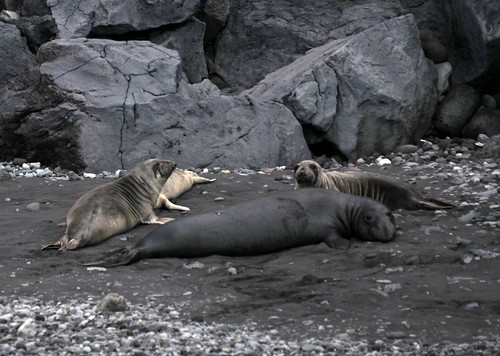
So you may recall a while back we visited Guadalupe Island off the coast of Mexico - this is as close as we got to it, checking out Elephant Seals from just off the coast.

elephants2

You must understand its not that we didn't want to visit its just that we were rather busy with these girls.....

white15

Which in a way is a shame because Guadalupe offers some interesting birdwatching opportunities. Unfortunately its not as interesting as it once was. You see in addition to the seals and sealions some other mammals made Guadalupe their home over the course of the last century - the kind of mammals you don't wanna see on any unique island: feral goats and feral cats. B

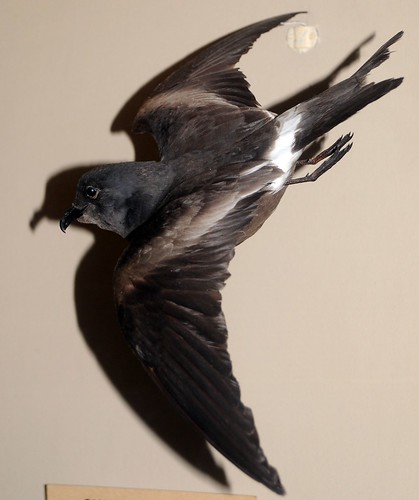
guadelupe petrel

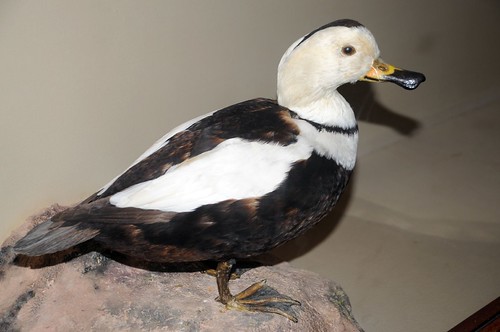
Above is a mount of the Guadelupe Storm Petrel (Oceanodroma macrodactyla) . Its extinct (probably - its hard to prove the negative that is extinction with birds that spend so long at sea). These guys used to nest on Guadelupe in burrows but the cats made that a pretty ineffective way to pass your genes on until they just dwindled and died out.

guadelupe flicker

Above is a mount of the Guadalupe flicker (Colaptes cafer rufipileus), another lost species. This one fell victim to goat decimation of its habitat. Since the extermination of the goats some (though not all species) of the plants have returned and the island has been recolonised by the mainland subspecies, Colaptes cafe cafer.

These are just two of Guadalupe's lost birds. Also lost were the Guadalupe Bewick's Wren (Thryomanes bewickii brevicauda) and the Guadalupe Spotted Towhee (Pipilo maculatus consobrinus). The Guadalupe Ruby-crowned Kinglet (Regulus calendula obscurus) is currently MIA, a search in 2000 failed to find one so it may be lost already.

Perhaps the saddest tale of all Guadalupe's lost birds though is that of the Guadalupe Caracara (Polyborus lutosus). The Caracara was intentionally made extinct by man in around 1901 in the belief that it preyed on young goats (ironically the same goats who's offspring would do for the Towhee, wren, flicker and probably the kinglet). What a mess we make.

Tuesday, November 17, 2009

Yet another extinct cycad

Well wow; what a spectacular cycad this was; huge leaves held relatively laxly with those big leaflets in an interesting shade I'd probably describe as sea-green in real life. This is Encephalartos pterogonus.

encephalartos pterogonus2

Why an "extinct cycad" when this is clearly a living plant? Well its not in the wild and nor are any other plants of this species. Originally from Mt Muruwe, Mozambique, it was discovered in 1949, described in 1969, and was extinct in its habitat by 1975, due to poachers....for shame. Its discoverer was a cycad collector called Raymond Munch and it was in Munch's garden as opposed to the wild that the material for the species' scientific description was collected in '69 by Robert Allen Dyer. If you're wondering about the name; pterogonus derives from pteron (wing - as in pterosaur) and gonas (seed) and refers to the distinctive wing-like and toothed appendages below the terminal facet of the microsporophylls." I can tell you that because of this awesome document, an absolute gem for the true botany nerd.

encephalartos pterogonus

A close up of the crown reveals a pair of beautiful young male cones beginning to emerge. Nice. This illustrates one of the reasons I'm relatively upbeat about this species' future. We know the identity of a number of the original plants and can produce unquestionably "true" E. pterogonus seedlings in captivity. We also know the type locality of the original colony so if the issue of poaching can be controlled I see no reason why some time in the future the species can't be restored. Perhaps by the time I'm an old man we'll be ready.

Monday, November 16, 2009

Froggy bycatch

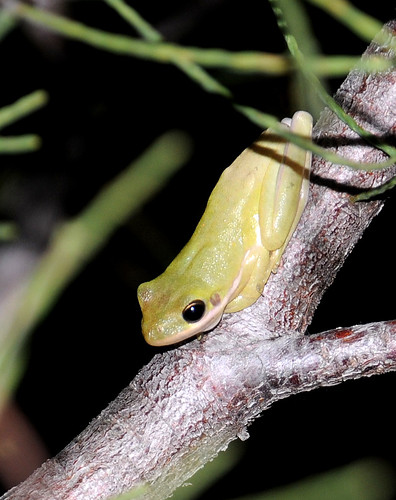
Whilst out searching for snakes, one can come across all sorts in the tropics at night. I heard these guys far more often than I saw one but I did track one down in a handy pose. This tiny little frog is Hyla cinerea - the American green tree frog, a tremendously widespread and successful little frog which ranges all across the southern USA except California.

treefrog

One thing I always miss when I return to temperate climes from the tropics is the chorus of the frogs in the evenings. Before I left Singapore I actually made a half-hearted effort to record a rainy night's frogs to play as background music and lull me to sleep back in the UK (if anyone knows of any good such recordings of Asian frogs I'm still interested in fact).

Thursday, November 12, 2009

Old friends

Recent birding hasn't just been a relentless quest to add to my new list as my last birding post may have suggested. On the contrary, after years in the tropics its been great to catch up with some old friends.....

snipe

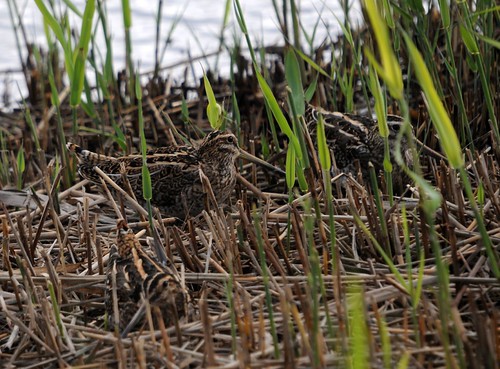
There were those snipe I mentioned previously.....Snipe may be my favourite birds of all. I don't know why, there is just something magical about their warm coloration and beautiful patterning and the way they reveal themselves from hiding (a post on that may turn up soon once all the other outstanding ones get done). I've always had an interest in birds but to the extent any one bird was my "trigger bird" into more serious birding this was it. Perhaps that's why they feature on the blog so many times. Of course having said that many of those snipe were Wilson's snipe from the tropics.

fem teal

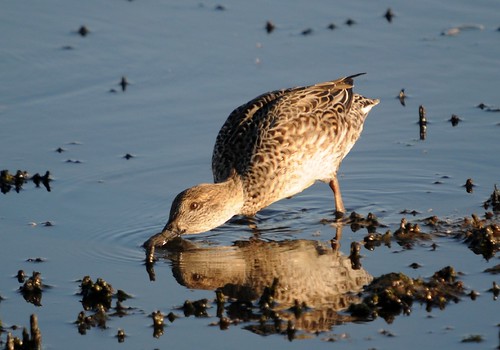
Eurasian teal is another old friend from European winters past. Of course again I spent my last 3 winters watching blue-winged and the odd green-winged teal bask in the caribbean sun.

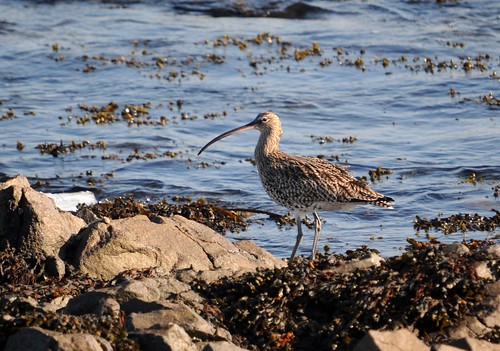
curlew

The curlew is a bird my father used to see a lot but these days not so much, we occasionally see small flocks near home now - they seem common here which makes me happy. I didn't catch up with a curlew in the caribbean though I did get a closely related whimbrel. So in a way all of my old friends' relatives helped me out whilst I was away when I was away and then they were waiting to welcome me back. I guess its a small world when you look at birds.

Lunar rays

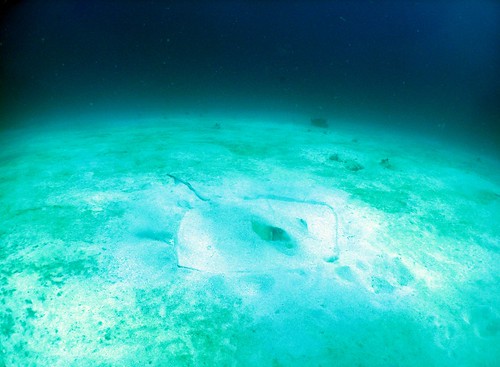
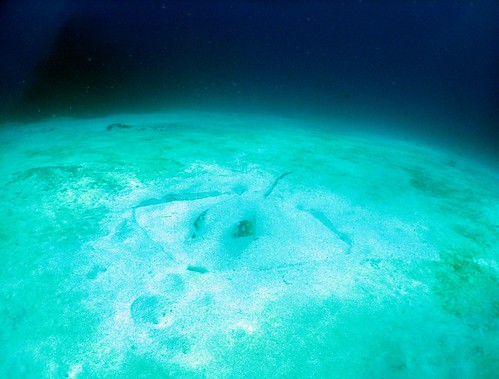
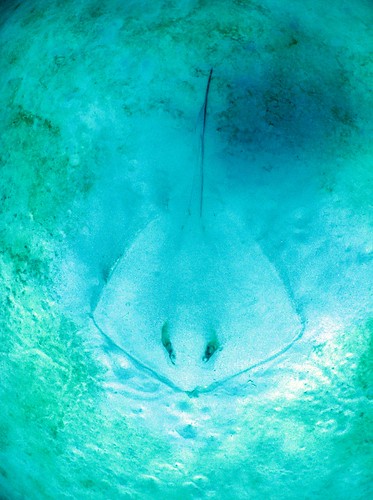
I've noticed before that running one of photoshops standard autocorrects on underwater shots sometimes produces unusual effects and as I took these shots I knew this would look cool with that altered scheme. Accordingly I hereby introduce the world to a stingray species that appears to live only in the sea of tranquility.

ray

The all important 3/4 angle....

ray3

and the other side:

ray2

That mordor style black mass in the left hand side on this shot is the corpse of a fire-stricken refrigeration vessel that sank in the early 80's