So for some time
the Tai Haku shark list has been sat on 29. I've been dry and without a new shark for far too long (I did see a hammerhead whilst fishing in north australia earlier this year which may have been a new species for me but alas untickable views!). Accordingly action had to be taken. Getting to 30 sharks has always been my bare minimum goal. Anything over 25 species is a lot of sharks. 40 and 50 species are both very much doable if you are a shark nerd willing to make some dive trips to some not so warm, not so traditional dive locations but 30 is a very decent number if you want to only do awesome dives. So the quest for #30 began and I knew straight away where I was headed and why. There is a shark I've been trying to see for over 10 years without success. A bogie shark if you will. As luck would have it it is also a rather big, rather spectacular species with some habits that will fuel a certain kind of adrenalin rush.
Film and shark buffs may remember this quote:
What we didn't know, was our bomb mission had been so secret, no distress signal had been sent. They didn't even list us overdue for a week. Very first light, Chief, sharks come cruisin', so we formed ourselves into tight groups. You know, it was kinda like old squares in the battle like you see in the calendar named "The Battle of Waterloo" and the idea was: shark comes to the nearest man, that man he starts poundin' and hollerin' and screamin' and sometimes the shark will go away... but sometimes he wouldn't go away. Sometimes that shark he looks right into ya. Right into your eyes. And, you know, the thing about a shark... he's got lifeless eyes. Black eyes. Like a doll's eyes. When he comes at ya, doesn't seem to be living... until he bites ya, and those black eyes roll over white and then... ah then you hear that terrible high-pitched screamin'. The ocean turns red, and despite all the poundin' and the hollerin', they all come in and they... rip you to pieces. You know by the end of that first dawn, lost a hundred men. I don't know how many sharks, maybe a thousand. I know how many men, they averaged six an hour. On Thursday morning, Chief, I bumped into a friend of mine, Herbie Robinson from Cleveland. Baseball player. Boatswain's mate. I thought he was asleep. I reached over to wake him up. He bobbed up, down in the water just like a kinda top. Upended. Well, he'd been bitten in half below the waist. Noon, the fifth day, Mr. Hooper, a Lockheed Ventura saw us. He swung in low and he saw us... he was a young pilot, a lot younger than Mr. Hooper. Anyway, he saw us and he come in low and three hours later a big fat PBY comes down and starts to pick us up. You know that was the time I was most frightened... waitin' for my turn. I'll never put on a lifejacket again. So, eleven hundred men went in the water; 316 men come out and the sharks took the rest, June the 29th, 1945. Anyway, we delivered the bomb.
A fair amount of the above is true even if Quint and the rest of Jaws is a work of fiction. The Indianapolis did sink, help didn't come for a long time and the sharks did come. A whole range of species has been named and associated with this tragedy but most agree that one of the most problematic species for the sailors aboard Indianapolis and countless others in our oceangoing history was
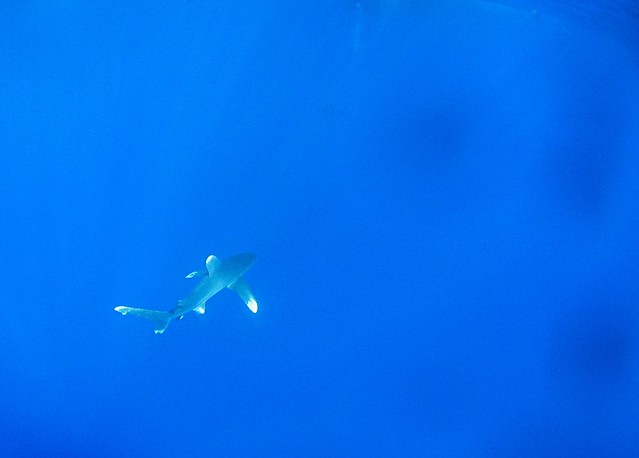
Carcharhinus longimanus. The Oceanic Whitetip.
Everyone who's ever seen discovery channel can tell you 3 sharks in whose presence you should be scared: the trinity of Bull, Tiger, Great White. This is the 4th horseman and yet it rarely encounters people. It patrols the deep blue pelagic desert far from the coast and tends only to be seen when attending boats (which it will follow for days). It is unlikely ever to strike swimmers near a beach (so are the others for that matter but
longimanus is less likely still to venture into the shallows). It is also becoming depressingly rare. Once the most numerous large predator on the planet (a measure of its perfect adaptation to the most available habitat on the planet), it is being fished out of existence.
These habits and problems make it hard to find one as a diver especially if, like me, you're disinclined to chum such a dangerous species up before getting in the water with it. There are a couple of places they can be found though and Elphinstone reef can be one.
Longimanus literally means "long handed" a reference to the species' great wing-like pectoral fins. It exists in a world where efficiency is everything, a perfectly hydrodynamic hunter cruising across a great blue desert expending as little energy as possible until it comes across an oasis; a structure of some kind, it could be a bit of floating wood, a sea mount rising out of the depths or a life raft. Structures attract small fish, small fish attract bigger fish and so on and so structures mean possible food for
longimanus....and so everything
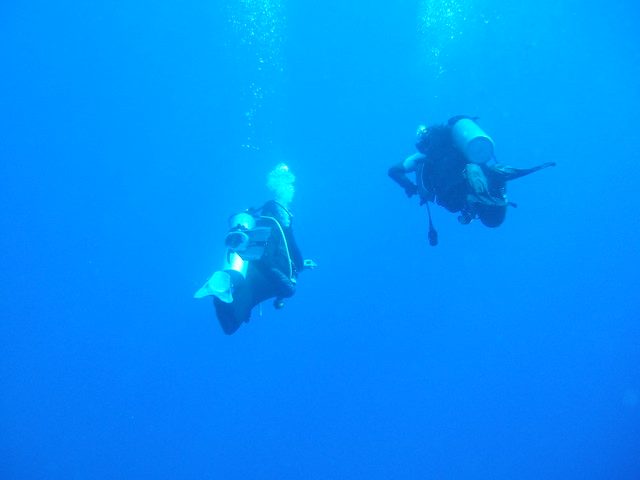
longimanus encounters must be inspected thoroughly. It will therefore sweep in close to divers, all its senses focused, assessing you from within touching distance before, having assured itself you're either inedible or too big and too much trouble, sweeping off again. A mindboggling experience from something that has the capacity to eat you and one I'd craved since dive number 14 when we left the wall of Jackson Reef in the Straits of Tiran hoping for company. 600+ dives later and still no luck. What better way to get my 30th shark? And so we rolled off the side of the RIB, descended along Elphinstone's vertical wall and swam out into the blue water.........................
...and on thursday what we saw will be revealed.