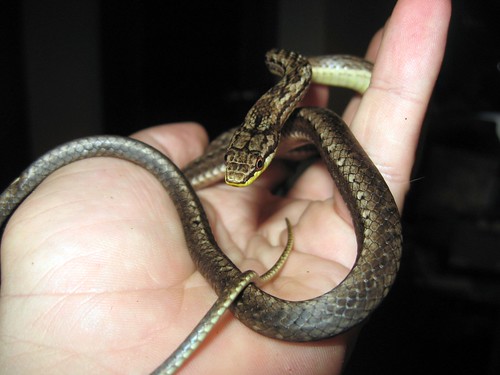
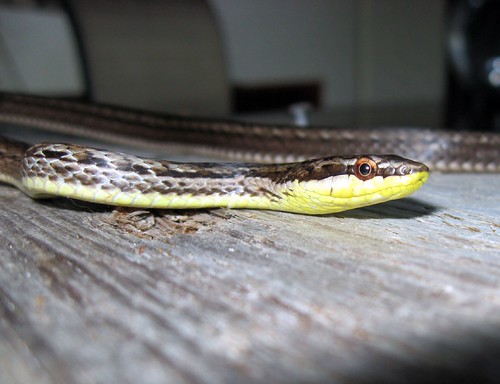
A day or so before New Years we bagged the last snake of a rather snakey 2008. This was our local Alsophis portoricensis, the Antillean Racer.
Tuesday, January 06, 2009
Monday, January 05, 2009
What I'd like to see......
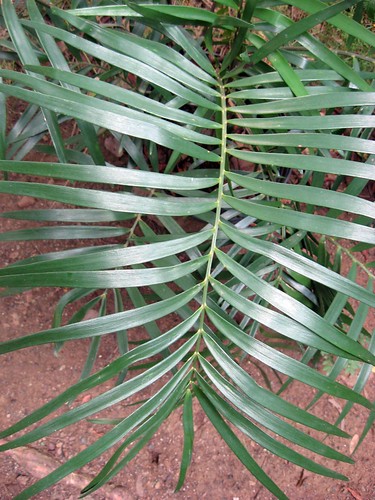
This pretty little potted cycad sat around at our local park reminded me of an important point I wanted to make about cycad conservation and the place of cycads in the environment. First things first, this is Zamia pumila which is basically your bog-standard caribbean Zamia. There are a number of different forms of this species reflecting different islands and habitats. This individual may be the cultivar known as "Dominican Republic".

I think we can probably all agree on the basic proposition that this is an attractive plant especially when compared with other plants with similar features - ie a couple of feet high with green fronds and so forth. It is also, like so many other cycads, basically bulletproof in terms of care - capable of withstanding extremes of shade and sun, drought and abuse. Cycads' fleshy leaves tend to be much more long-lasting than palm or fern fronds or ordinary plant leaves so if there is a period of drought this guy will sit in the ground chilling and looking exactly the same whilst other plants wilt, shed leaves or go brown. A little rain and new growth will burst out. This toughness therefore makes this, like many other cycads ideal for use in municipal plantings. Their long life and the relative rarity of random hybridisation means cycads are in an ideal position for "captive breeding" and hence preservation by means of such cultivation.

Of course many cycads are currently too rare for such use but for species like Zamia or Ceratozamia localised production of a fair number of young plants relatively quickly is not difficult to imagine as they cone at a young age. As such one can imagine that if plants held by collectors, enthusiasts or public gardens are pollinated and seed is made available, mass plantings of species like Zamia pumila here could be making a welcome appearance greening certain areas where all else fails like verges, central reservations, "hell strips" and so forth across the caribbean without the need for irrigation or pruning. The more commonly this occurs - the more common each species to form would become, the more common each species or form becomes the cheaper it is to use said species for these jobs and the better protected they become. It really wouldn't take all that many plants to secure a species or forms future when kept in groups like that. Just imagine a town council in, say Florida, or a hotel in Grand Cayman being able to say "we've reduced considerably the costs of maintaining these areas, the seeds we sold paid for part of the initial outlay and by the way we helped preserve an endangered species whilst we did it."

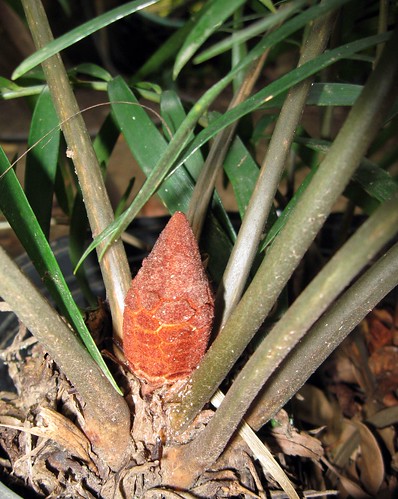
Starting such a process could be as simple as one person collecting seed from their cycad, passing on offsets or making the effort to pollinate it. By way of proof that one does not need a lot of room to have seed producing cycads; the above plant in its little pot has a female cone! Of course there will be a few cycads that will never be suitable for this - the epithytic Zamia pseudoparasitica for example - but we could save so many of these wonderful plants with a little will. I'm hoping increased use of other Zamias such as Z. furfuracea and Z. lodgesii in dry tropical gardens may lead a few bright sparks to the same conclusion and that some of them may follow through on it and at least a few species may benefit.
Sunday, January 04, 2009
Corrections: I'm an idiot......
Well maybe not an idiot but like everyone else I do make mistakes. Particularly in the area of botanical identification. Accordingly the following posts just got amended to correct some mistaken identifications:
Blue Steel - the palm in question isn't Brahea armata but in fact Bismarckia nobilis.
Got Coonties - the cycad in question is Zamia pumila - I wasn't sure on this one originally.
Another relic - the cycad in question is Zamia amblyphyllidia not Z. furfuracea (this one is rather embarassingly off - not sure what I was or wasn't thinking at the time).
Sorry!
Blue Steel - the palm in question isn't Brahea armata but in fact Bismarckia nobilis.
Got Coonties - the cycad in question is Zamia pumila - I wasn't sure on this one originally.
Another relic - the cycad in question is Zamia amblyphyllidia not Z. furfuracea (this one is rather embarassingly off - not sure what I was or wasn't thinking at the time).
Sorry!
I got nothing.....except some weird dolphins!
So, you may have noticed a lack of underwater photos of late. Truth is I haven't managed to get properly underwater since November for reasons of excessive business. I managed to rectify this with a little snorkelling yesterday but broke my own cardinal rule ("Always, always, always take a camera in the water with you in case you see something awesome") suffice it to say I saw something awesome. Imagine if you will a photograph of 2 huge eagle rays circling a 7 foot nurse shark here:
To try and make up for this here are some old photos, topside but of a very interesting sea beasty.
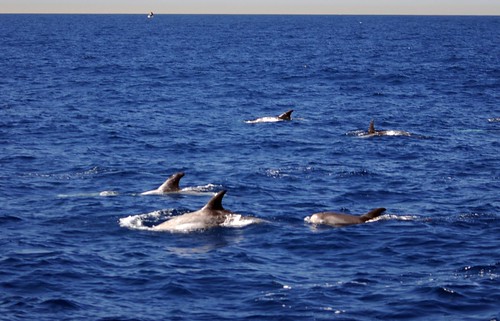
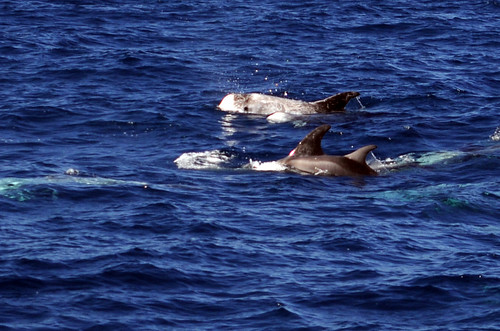
These are Risso's dolphin, Grampus griseus, which for literature fans amongst you is the origin of the phrase "puffing like a grampus". This was a huge pod of Risso's, that's a juvenile at the bottom right. Risso's are a weird dolphin - funny coloured, beakless, pretty big. Heaven knows what this big pod was up to.
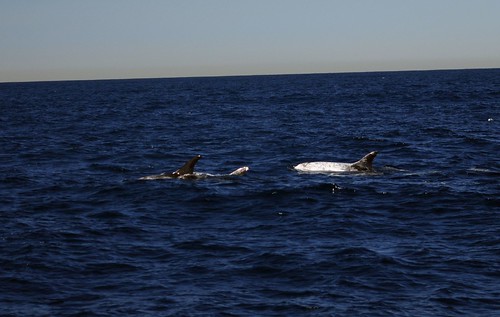
Note the baby is darker, smoother grey whereas the adults are mottled and much lighter - this image shows this strange colour scheme better.
This image is the best I have of the Risso's melon-headed, beakless face. Risso's weren't the only dolphins in the region though, that's a common dolphin in front I believe.
[ ]
fig. 1: Tai Haku is kicking himself this is blank space and not an awesome eagle ray and/or shark photo.
To try and make up for this here are some old photos, topside but of a very interesting sea beasty.
These are Risso's dolphin, Grampus griseus, which for literature fans amongst you is the origin of the phrase "puffing like a grampus". This was a huge pod of Risso's, that's a juvenile at the bottom right. Risso's are a weird dolphin - funny coloured, beakless, pretty big. Heaven knows what this big pod was up to.
Note the baby is darker, smoother grey whereas the adults are mottled and much lighter - this image shows this strange colour scheme better.
This image is the best I have of the Risso's melon-headed, beakless face. Risso's weren't the only dolphins in the region though, that's a common dolphin in front I believe.
Friday, January 02, 2009
new year's festival
Berrygoround is up at Foothills Fancies and it is excellent for the plantlovers amongst you.
top 10 nature moments of 2008.....
So i thought I'd wait until 2009 officially started to unleash the top 10 nature moments of 2008 meme. Below are my biggest moments of the year (nature-wise):
1. A peregrine falcon hitting a blue winged teal right in front of me - I was close enough to hear a bang on impact.
2. Isla de guadelupe, Huge great white sharks, a little cage, me and a hundred foot visibility. I doubt anyone could leave this out of their list.
3. Ricord's and Rhinoceros Iguanas feeding together in the Dominican Republic.
4. A huge pod of Risso's dolphins crossing our bow on the way to Mexico (photos to come).
5. Finally catching up with our seahorses, red, stripey and, er, fuzzy.
6. Rekindling my fascination for the cycads all over again at San Diego Zoo (and properly rekindled it is too - I spent this morning relentlessly photographing and identifying some more species).
7. Watching Humpback Whales feeding off the coast of Boston.
8. Standing at the foot of the General Sherman tree, the world's largest living thing, in California.
9. Getting my first really good looks at the mighty Blue Marlin.
10. The overwhelming feeling of hope that came with seeing dozens of Grand Cayman Blue Iguanas - formerly the rarest reptile in the world.
I'm a little surprised there was only one bird on the list - an awesome sighting but to be honest the best of a quiet year for birds. The iguanas were great and symptomatic of a wonderful year with reptiles - lots of lizards, turtles and snakes. I'm going to turn this into a meme again and go tag some people. If you want to participate, just share your top 10, drop me a comment and I'll collate everyone's lists. Here's 2007's participants.
Update: I've tagged Patrick at Hawk Owl's Nest, Amy at WildBird on the Fly, FC at Pure Florida and Duncan of Ben Cruachan.
The Ethical Paleontologist and 10,000 birds' Corey have already put up their lists.
1. A peregrine falcon hitting a blue winged teal right in front of me - I was close enough to hear a bang on impact.
2. Isla de guadelupe, Huge great white sharks, a little cage, me and a hundred foot visibility. I doubt anyone could leave this out of their list.
3. Ricord's and Rhinoceros Iguanas feeding together in the Dominican Republic.
4. A huge pod of Risso's dolphins crossing our bow on the way to Mexico (photos to come).
5. Finally catching up with our seahorses, red, stripey and, er, fuzzy.
6. Rekindling my fascination for the cycads all over again at San Diego Zoo (and properly rekindled it is too - I spent this morning relentlessly photographing and identifying some more species).
7. Watching Humpback Whales feeding off the coast of Boston.
8. Standing at the foot of the General Sherman tree, the world's largest living thing, in California.
9. Getting my first really good looks at the mighty Blue Marlin.
10. The overwhelming feeling of hope that came with seeing dozens of Grand Cayman Blue Iguanas - formerly the rarest reptile in the world.
I'm a little surprised there was only one bird on the list - an awesome sighting but to be honest the best of a quiet year for birds. The iguanas were great and symptomatic of a wonderful year with reptiles - lots of lizards, turtles and snakes. I'm going to turn this into a meme again and go tag some people. If you want to participate, just share your top 10, drop me a comment and I'll collate everyone's lists. Here's 2007's participants.
Update: I've tagged Patrick at Hawk Owl's Nest, Amy at WildBird on the Fly, FC at Pure Florida and Duncan of Ben Cruachan.
The Ethical Paleontologist and 10,000 birds' Corey have already put up their lists.
Subscribe to:
Posts (Atom)