Tuesday, September 07, 2010

Holy crap - what was that!

Big, day-flying bats are something that takes a little getting used to. Arriving in Biyadhoo I was pretty shocked to see one of these go over my head. Its not that they are particularly unexpected there, it is just that they are a) massive and b) totally unlike birds in flight and hence very unfamiliar silhouettes to have in your peripheral vision. When people talk about frigate birds as prehistoric or primeval looking I don't always get it. These things are really primeval looking.

flying fox

I spent my non-diving time failing to get good photos. of these The jungly nature of the interior of the island, cut through with paths, left very narrow "shooting lanes" in which to pick up a fox, get the camera on it, focus and shoot before it was obscured by vegetation again. I attribute the shot above solely to the training my reactions got on a charity skeet shoot a couple of weeks earlier.

I'm pretty sure this is Pteropus giganteus ariel; the Maldivian subspecies of Indian Flying Fox. There is a second Pteropus species found in the Maldives (Pteropus hypomelanus - the small flying fox). I've identified these animals as the former based solely on scale. They are too big for hypomelanus (I believe). It is a fruit eater and seemed to like roosting in coconut fronds - generally it's a gregarious species but I didn't manage to find a big roost of these on the island. Incidentally you may have heard the theory that flying foxes are actually winged lemur-type primates as opposed to big bats. Its a cool theory and it suggests an explanation for the lemur looking head these bats have. Unfortunately it is also probably wrong as Darren explains with typical skill here.

Monday, September 06, 2010

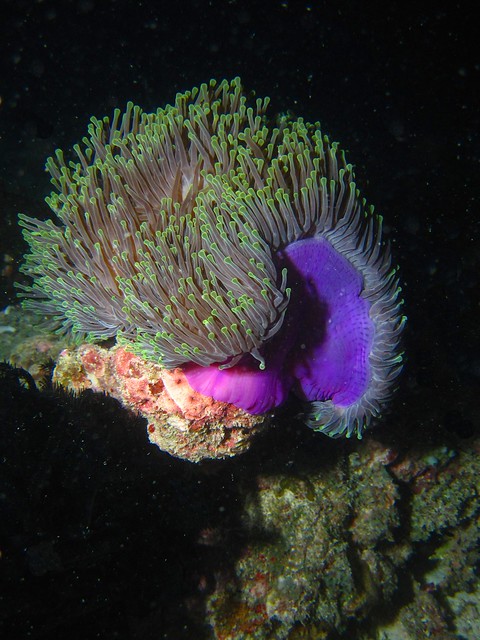
Magnifica!

How about we take a look at a sea anemone without one of those annoying clownfish in the way stealing all the focus?

magnifica

Kind of magnificient in its own right n'est-ce pas? It should be; this is (I hope) Heteractis magnifica aka the magnificient anemone (also known by a number of other names including Ritter's anemone). This bad boy grows to almost 3 feet across and was (for understandable reasons) once a popular aquarium species. It will feed on both invertebrates and small fish and it tends to live in high surge, high light zones up on the reef. This surge is the reason for the windswept look above and also for the milky way looking background (surge = suspended particles = backscatter). This habitat is also the reason it is very, very hard to properly maintain in aquaria; Entacmaea quadricolor, the bubbletip anemone is a much better choice as it is easier to maintain and can be bred (well actually cloned) in captivity. Getting back to magnifica, the colour scheme can vary but this purple/green form seems pretty widespread. There also seems to be a pretty common bright red footed form and the tentacle colour varies with the health and type of the photosynthetic cells in the tentacle.

There were actually a couple of blackfooted anemone fish (the Maldives' endemic clownfish) in there somewhere. I think (hope!) I have some shots of those somewhere too for a later post but for now lets enjoy the anemone - it's more than just background filler out there on the reef.

Thursday, September 02, 2010

Coming out in hives,,,,,

So I've always loved keeping insects (sadly the cool phasmids preceded digicams and blogging - maybe next year.....) and inspired by a) a love of honey, b) various online sources including but not limited to the Birdchick and @neilhimself, c) a fascination with bees and bee accessories, d) the fact that beekeeping is the new rock and roll and e) ongoing dreams of a Candyman style vengeance on my adversaries (OK, d) and e) aren't genuine reasons) I've signed up to a beekeeping course. In spite of very high demand I think I've been accepted so I'm pretty excited by the thought that maybe by this time next year I'll be hived up. So I've been paying attention to the bees of late and was interested to see this hanging outside hotel reception in Sri Lanka....


hive

It was surprisingly not noticed by a lot of guests stood underneath it. I guess this is how wild bees roll in Sri Lanka. Its much more preferable to how bees roll in Venezuela: a little more than a year ago I was under attack by a swarm of africanised "killer" bees!

Wednesday, September 01, 2010

Nearly wordless wednesday - Tubmonster

tubmonster

This has been in the bath of my guest bathroom for the last few weeks. For non-brits that is a 50p coin which wikipedia tells me has a diameter of 27.3milimetres or 1.074 inches.