At last I get to a post I've been hoping to make for quite a while. Ever since I heard that a population of Burmese Pythons (
Python molurus bivitattus) had established itself in southern Florida I was keen to go look for and photograph them. My first effort failed miserably but I went back recently. As most nature-lovers have probably heard this colony established itself due to releases by irresponsible pet-owners. About as irresponsible as it comes in fact - Burms are huge, among the largest snakes in the world and capable of getting up close to the 20 foot mark. In nature they are aggressive ambush predators willing to attack pretty much anything - we've all seen
that alligator photo after all. So its potentially a disaster although how bad it will be we don't really know and some of the news coverage of the issue has represented scaremongering of the worst form.
If you want to find pythons a little online research will hook you up with better details than I can provide of how to do it. Suffice it to say if you go looking bear in mind a) the laws of the national park, b) other much smaller animals in the same area (I came across an array of awesome visual bycatch including 5 nocturnal bird species, 10 snake species and a coyote) and c) your own safety. Anyway I found one (just outside Everglades National Park if anyone is interested) and here it is posing with a Toyota Camry for scale.
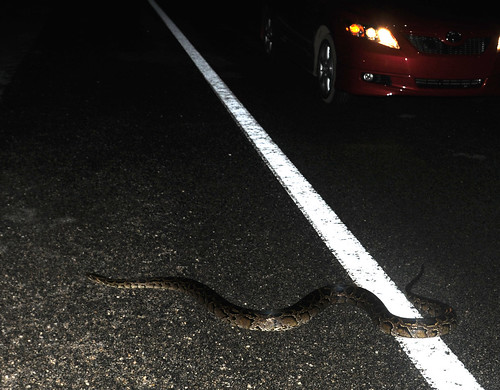
Its worth noting that upon first seeing it I immediately thought python but then briefly pondered whether I'd come across the mother of all eastern diamondback rattlesnakes due to its tail shape and patterning. It was keen to be away from me but not bitey which was a pleasant surprise. Notwithstanding that a look from this dogfaced head gives one pause for thought in getting closer.
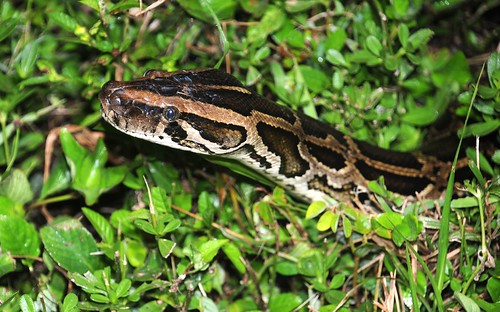
Collecting or controlling a snake this size is definitely a job for someone who knows what they are doing (and really to be truly safe this is something that should only be attempted when you have someone to act as back-up). Eradicating this population is going to be a collossal task. Burms are a lot faster on land than
anaconda and in this scrub it was moving pretty quick. Its perhaps worth noting that African Rock Python, Anaconda and Boa Constrictor have all been found in the wild in Florida too (along with a few other unconfirmed tales of more ridiculous giant reptiles still) but these species appear to not be expanding their populations with the same success which is lucky. Burms are obviously well adapted for these conditions - I'd be pretty worried about a population of reticulated pythons if one were found (I think they'd be supremely suited to the 'glades) but I suspect temperature will prove a limiting factor if such a thing were to happen.

As you can see these guys have beautiful patterning. Below is the last shot I have of this beast. Immediately after I took it I walked away to deal with something briefly with the intention of coming back for more shots. When I returned 30 seconds to a minute later this huge snake had managed to completely disappear. Which is kind of scary.
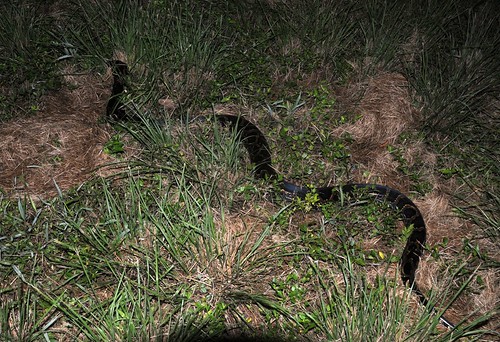
So there you have it; an encounter with a truly impressive, not too mention beautiful, creature which will live and die in completely the wrong place causing untold ecological damage. Notwithstanding my pleasure at a mission accomplished this one left me with an uneasy feeling.