Tuesday, July 07, 2009

Venezuelan Raptor Week 2: Burrowing Owls

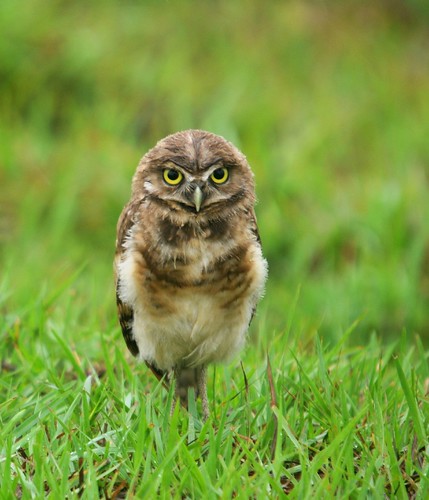
I don't know if there is a cuter bird than the burrowing owl. How sweet is this youngster?

burrowing owl7

I tend to think of these as golf course owls for some reason. I've been doing a lot of thinking about how public amenities could be adapted to accommodate wildlife and my mind keeps drifting back to the idea of an uber-wildlife friendly golf course (a greening of the greens if you will….). The southern north American version as constructed in my mind always has a few colonies of burrowing owls decorating the rough. Perfect no? Notwithstanding this the Hato el Cedral owls (in the absence of a fictional golf course) have gone for the verges of the various farm tracks as the location of their burrows and we located five or so groups (I'm sure there are more).
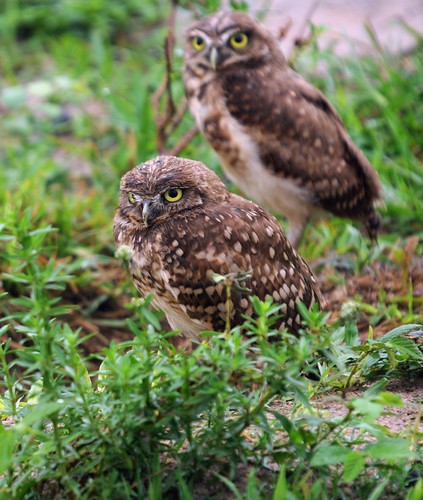
burrowing owls1

For those unfamiliar with these chaps they belong to the same genus (Athene – named for Athena greek goddess of wisdom, peace, warfare, strategy, handicrafts and reason, shrewd companion of heroes and the goddess of heroic endeavour (and fan of owls)) as the little owls and are widespread through southern north America, central and south America – wikipedia offers up a list of 22 subspecies of varying validity. I have these ones down as falling within Athene cunicularia apurensis. These ones tended towards rather small groups although I did wonder if we were seeing a single long colony rather than two different ones a couple of times due to the linear nature of the track habitat. These guys feed on everything from insects and frogs and rodents up to small birds. Wikipedia mentions predation of things as big as Zenaida doves which frankly would be remarkable to see. With that being said I guess it really doesn't pay to make them angry….
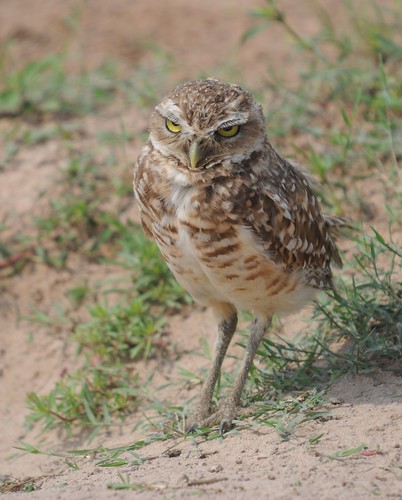
burrowing owl

I don't know what I did to deserve this but if looks could kill you would not be reading this right now.

Monday, July 06, 2009

Venezuelan raptor week 2: Yellow Headed Caracara

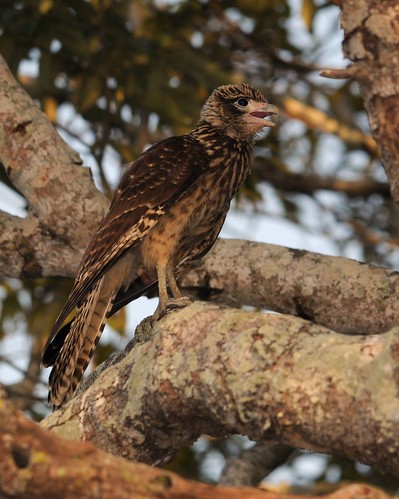
Yellow Headed Caracara? This is nonsense - It doesn't even have a yellow head!

yellow headed caracara juv1

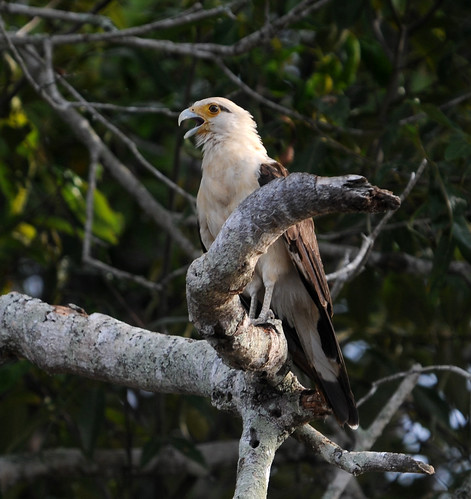
Actually that was just a (particularly whiny juvenile). Here's its parent (which was also making a racket):

yellow headed caracara1

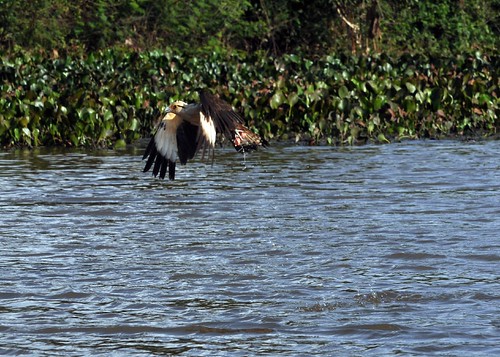
These attractive little raptors were probably the most commonly seen species in our time in the Llanos (after the massed vultures). They seem to be rather generalist and are by no means lacking in smarts. The two above had worked out they might be able to wrangle some of the chicken that was being fed to the caiman (as seen here) and squawked their hearts out til they got some. Meanwhile the one below dived in to nick a bit of fish that our guide had intended to use to lure a black-collared hawk from its perch. I had to crop this photo to make the caracara stand out for the blog but in the original there are a pair of enormous feet looming into the top of the frame as the black-collar arrives a fraction of a second too late.
yellowhead caracara

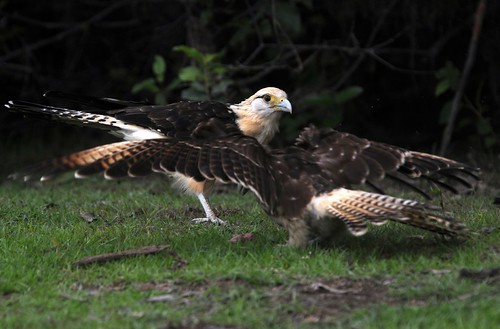
They also seem to be endearingly social, we would often see them flying in pairs or following one another with only the occasional squabble….

yellowheaded caracaras

Friday, July 03, 2009

Encephalartos kisambo

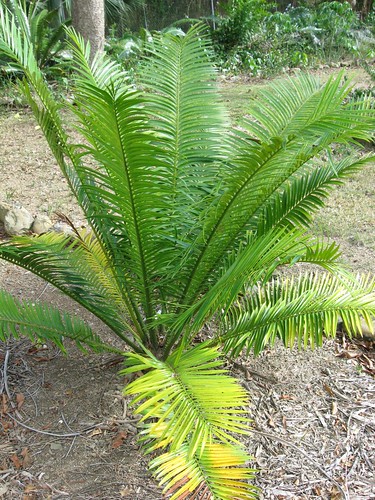
From St. Georges Botanic Garden, St. Croix I present a plant labeled as Encephalartos kisambo.

enceph kisambo2

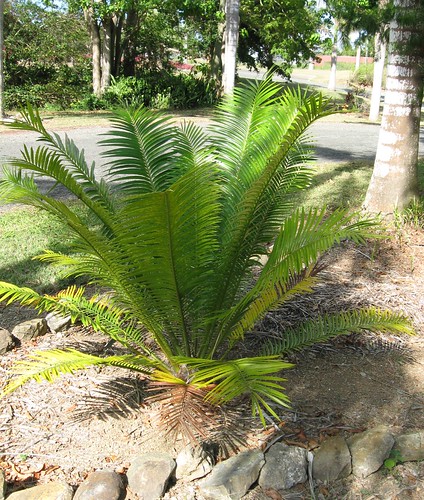
This one is sometimes known as the "Voi cycad" as it grows on a number of hills in the Voi District of Southern Kenya. Its specific name "kisambo" stems from its name in the local Taita language. As you can probably tell from the above its a very neat structured looking cycad and popular with growers as a result. It'll put out up to 14 foot of stem crowned with 12 foot leaves and will clump nicely. Also its cones are a rather cool yellow colour. This one associates with open mist forest.

enceph kisambo

Speaking of cycads, I am currently (assuming this autoposted correctly and you're reading it on the day it posted) perusing a vast collection of the wonderful green shuttlecocks and will hopefully have some photos of some very interesting, some disturbingly quirky and some scarily rare species to share on my return. There may also be some herps, big and small, expected or unexpected and, if I'm very, very, lucky possibly even shark #30. Meanwhile next week will be autoposted and will be Venezuelan Raptor Week 2. There are 6 awesome species to come and I'm currently deliberating over which one gets bumped.

Thursday, July 02, 2009

Two on the reef

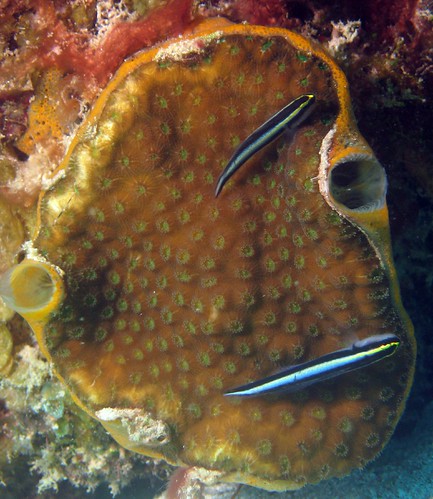
I rather like these photos. This is a pair of sharknose gobies, Gobiosoma evelynae, from saturday's dive. I like these little chaps for a number of reasons.

gobiosoma

I like Gobiosoma because when I was 9 and my parents got me my first tropical marine tank the first fish I got was a tiny little captive bred Gobiosoma which was a tremendous character. Gobiosoma are among the few marine fish species that can be categorised as "easy to breed" although for marines "easy" actually means pretty damn difficult. Still I like them because they at least give you a chance. I like them because they are cleaner fish and so if you sit still in front of them long enough there is a chance one will move over and start plucking at the hairs on your hand and I like them because they hang out in these cute couples like a pair of teenagers in a park. But that's not why I like these photos.

gobiosoma2

I like these photos because they are the ones I hurriedly took to make sure my strobe was working properly immediately before one of my friends proposed to another of my friends underwater with me trying to capture the moment. That's why I like these photos and that's just another reason why Gobiosoma evelynae will always make me smile whenever I see them.

Wednesday, July 01, 2009

Big greenie

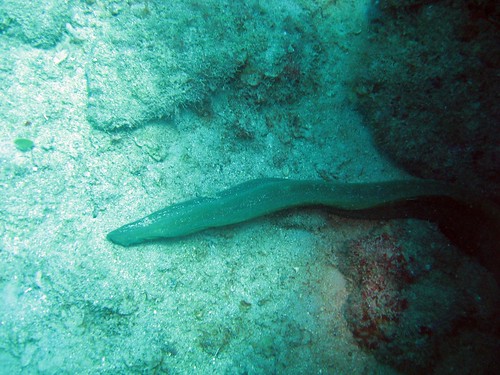
So whenever you see a 4 foot tail sticking out from under a rock, you really have to get down under the rock too to find out what's down there. This wasn't really a surprise.

green tail

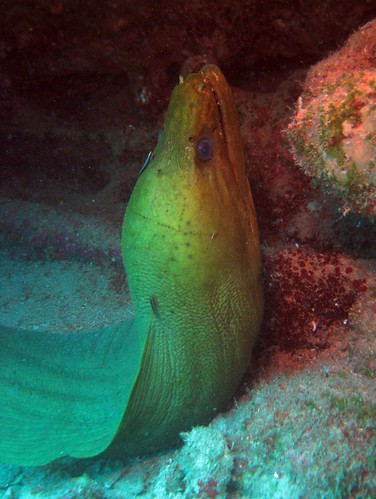
The tail here belongs to the green moray below. Green morays are our biggest morays and, to my surprise, I think this may be the first one to appear on E,W&W. I see them far less frequently than the spotted or goldentail morays and they get a lot bigger.

green moray

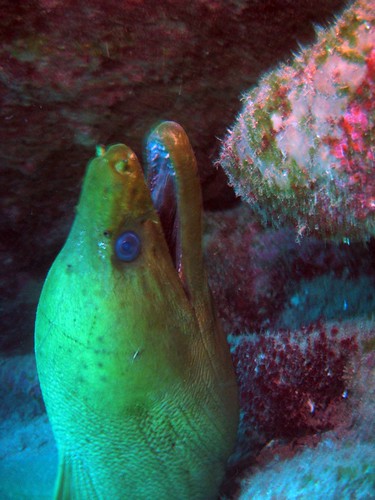
This eel is currently occupying a place in green moray legend. It is resident on the wreck of RMS Rhone. In the film The Deep a monstrously big green moray menaces various people apparently so, as the current incumbent on the wreck, this guy has a job to live up to any number of tourists' expectations. It moves around the wreck a lot which is unhelpful when trying to find it but it turns up fairly regularly. If you are wondering what the stripey thing near its left eye is we'll be getting to that shortly.

greeny
The shot clearly shows the rows of ragged teeth in side the mouth - this is a fisheater so it has the big ripping bite to do the job. On a friendlier note, this one is sometimes called kermit by guides (on account of being green and glove puppet like).