Thursday, May 07, 2009

Some cuteness

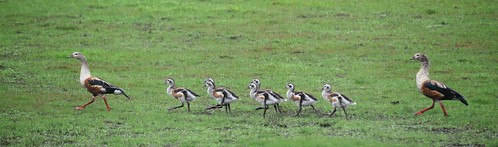
So after that ant, I thought we needed something a little cuter. These are Orinoco Geese. That's mum or dad at the front and dad or mum at the back with the kids lined up in between,

orinoco geese3

I think this may end up as one of the banners at the top of the page as I really like it. I'm told these guys are always very very protective. i'm also told its not unusual to see goslings disappearing at regular intervals as crocs, caiman, snakes and perhaps even pirranha knock them off. These guys look to be doing pretty well.
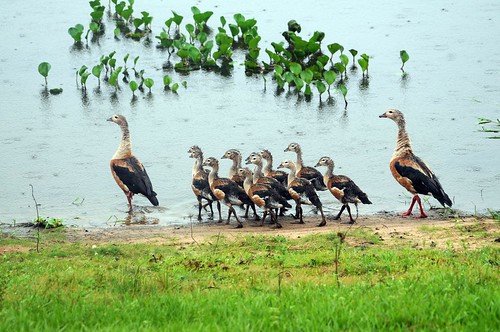
orinoco geese

These guys are doing even better - their goslings are older and more numerous. They were also rather neat but unfortunately I only took pictures on the day they were wet and bedraggled after the rain.

Tuesday, May 05, 2009

24 hours in a day

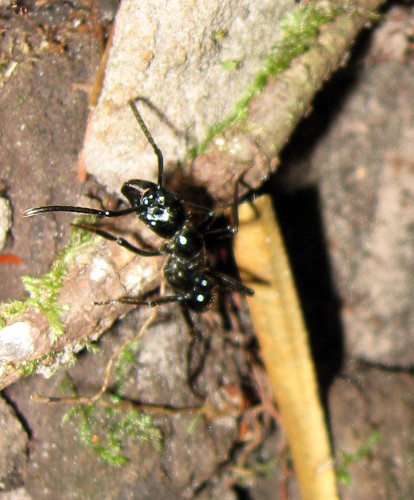
Sometimes, of late, I've wished that there were more than 24 hours in a day - there seems to be an awful lot I want to do and not enough time to do it. Anyway that mini-whinge was really just a way to segue into this little monster (the venezuela posts are going to be roughly a 50-50 split between gorgeous birds/fluffy mammals and the sort of beasties that have their own 50's B-movies):
24 hour ant

This is (I'm told) the "24 hour ant" (see what I did there?) which is in the bullet ant genus. I think this is Paraponerva clavata but I'm really not sure. Why 24 hours ant? Well because those front mandibles will give you 24 hours of painful misery if it clamps on. Good name; simple and it makes sense really (almost as good as the hundred pacer). According to wikipedia "A paralyzing neurotoxic peptide isolated from the venom is poneratoxin. The bullet ant's bite is so powerful that if it bites an object that is too hard to break, the ant will be flung into the air from the force of its jaws." Even more awesome is the fact that these bad boys rank number in the one Schmidt Sting Pain Index. The what? Well basically this guy Justin O. Schmidt has been stung by pretty much everything in his work as an entymologist and made a scale of the pain inflicted. Fire Ants are 1.2, Honey Bees 2.0 and these things? 4.0+. To quote Schmidt "Pure, intense, brilliant pain. Like fire-walking over flaming charcoal with a 3-inch rusty nail in your heel."

I weighed all this up and when it ran off decided not to shepherd it back onto the path for another photo.

Monday, May 04, 2009

Air Caiman - The Movie

So with my memory issues and photo-editing backlog still unresolved as Monday morning draws near all that remains is for me to offer you the video to accompany last week's flying caiman photos:

Friday, May 01, 2009

A break in the chain

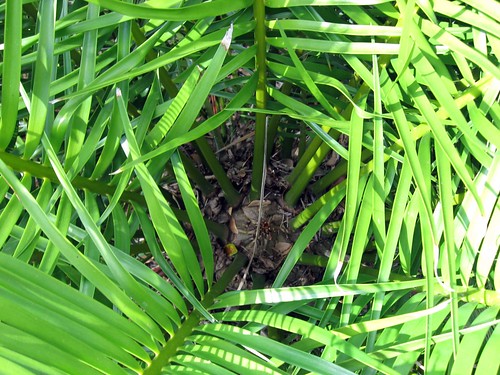
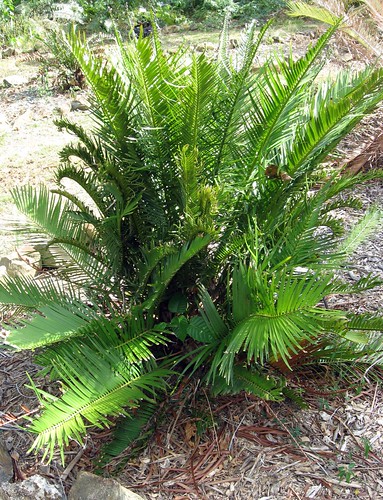
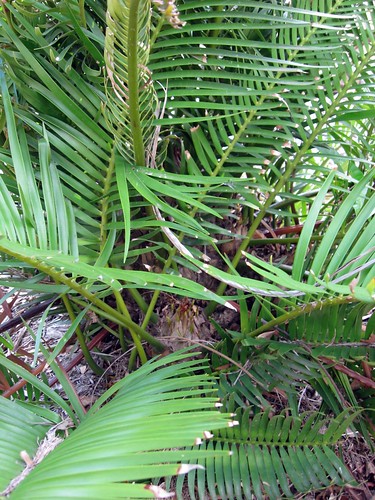
This is the very attractive Zamia inermis. Its from the Americas, Veracruz, Mexico to be precise and is like a lot of Zamia a rather attractive proposition for the tropical gardener. In fact it may be more attractive than most because inermis means literally unarmed a reference to the absence of spikey bits on this species.

zamia inermis3

Notwithstanding its attractiveness though Z. inermis is a cycad in big trouble. A dramatic reduction in its habitat together with overcollection have left a single wild population extant and that population is at constant risk from wildfire. Worse is to come however.

zamia inermis

Zamia inermis suffers from extremely low population recruitment in the wild. Female cones don't seem to produce many seeds. This is not, however, typical of the species. Cultivated females produce good numbers of seeds when artificially pollinated which suggests the issue in the wild is a lack of pollen. It is believed that this is due to the plants' natural pollinators being wiped out by injudicious use of insecticides. Many cycads have quite specific pollinators so this is a realistic hypothesis.

zamia inermis2

No less an authority than LA cycad legend Loran Whitelock (of Ceratozamia whitelockiana and Encephalartos whitelockii fame - yeah, 2 species named on your honour = major cycad legend) suggests that "virtually no regeneration is taking place in the wild". This is really bad news for the wild population and this may be one that has to be nursed in a captive population for the forseeable future. The good news however is that as Loran noted in 2002's The Cycads "without doubt Z. inermis could become a very popular landscape plant if it were available in sufficient numbers. There is no reason why it could not be artificially propagated in numbers large enough to secure its place in horticulture". That remains true today and is pretty much where the species sits now secure but not yet widespread in horticulture. In the early part of this year seed produced by Fairchild Tropical Garden in Florida was offered to growers through the Cycad Society's seedbank and plants themselves are available from a number of specialist nurseries. I do however worry that in the future collectors, nurseries and botanic gardens may be the only place we can see this one.