Friday, November 05, 2010

camouflage: FAIL!

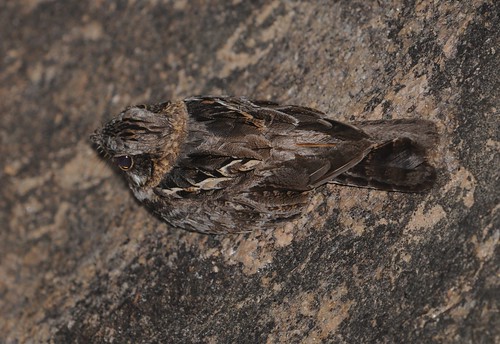
Stop the jeep! I yelled. Brakes were slammed and various people started scanning desparately for the bear or leopard I'd obviously just spotted up in the distant rocks. I pointed out the tiny nightjar on the rock next to the jeep. It remained stock still, convinced its camouflage would see it safe and we took our photos and marvelled at its perfect plumage.

nightjar

I think this is Jerdon's Nightjar, Caprimulgus atripennis, but I don't know much about nightjar. What I do know is that it was absolutely perfectly camouflaged and we got close enough to really check out that camouflage as well as the huge mouth, the weird whiskers and those big eyes.The next day my eagle eye spotted another perfectly camouflaged night jar blending in perfectly with it's surroundings.

nightjar cammofail

Hey. I never said they were smart. Joking aside I've never seen a nightjar in the UK - they're one of those rarish birds you can see if you make the effort to go to the right locations and I never have. I've seen them in the Caribbean though, and in North and South America and now Asia and I'm a little jealous I don't get to see them more often. There's a wildness about these sorts of birds I rather like.

Thursday, November 04, 2010

A boaring walk

One of the themes of my various travels (and hence, I think, of this blog) is that the supporting cast are often as (or sometimes more) interesting than the feature attractions. In Sri Lanka's Yala National Park the big features were leopard and elephant but there were plenty of smaller distractions too in the form of squirrels, deer and what not. Being in good country means even the walk to the hotel restaurant can be interesting.....


Quality's a bit off due to the low light levels but you get the idea (and no, I didn't have pork that night). These are the same species as the wild boar found across Eurasia (and as domestic pigs for that matter) but are of the subspecies affinis. Sus scrofa affinis is a smaller form of boar, the subspecific status of which has been questioned, but even so it looks pretty big looming at you out of the gloom at point blank range.

Tuesday, November 02, 2010

The power of prophecy.

So Corey has a post up over at the newly supersized 10,000 Birds on the topic and its something I've tried before (with limited accuracy - did not see that emu coming! (no I didn't tick it!)) and I thought I'd try again. I'm talking about the skill of list growth prediction or as I like to think of it, birding soothsaying, the dark art of tick prophecy if you will. Simply put; what do I think will be the next ten ticks on my island list? Well a highly skilled birder who knows the area well could probably pick up a big chunk of what follows easily but I'm still getting used to what to look for where here; we have limited habitat as its a small island so birds are concentrated. Its also worth noting that some more common birds (passerines mainly) not on the list below don't feature as its unlikely I'll be in a position to pick them out before I find the below as a result of my lack of warbler skills and the time of year we're in.
  1. Pintail - I should probably already have one of these on the list, there is at least one kicking around on the island right now and I've already had crippling views of a pintail x mallard hybrid so I reckon I'll pick up one of these sooner rather than later.
  2. Hen Harrier - this is an eye to the skies job. Whilst not common it's a big conspicuous bird which travels through the island from time to time. I reckon I may see one at some point this year randomly overhead or hear about a twitchable one.
  3. Short Eared Owl - we're rich in habitat for these and again, it's a big, recognisable bird on the wing so I should be in with a shout....
  4. Goldcrest - a garden breeder up at my parents' and we have loads of these here too but skulking in deep cover. I must surely nail one down this winter having failed all last year.
  5. Firecrest - as for goldcrest (but without the bit about my folks' house).
  6. Brambling - Loads of chaffinch and greenfinch flocks around that I think I need to pay more attention too until I pick out a Brambling (or something else).
  7. Mediterranean Gull - there are a few of these around amongst the black-headed gull flocks I occasionally check (thus far unsuccessfully) [similarly possible alternative tick: Yellow Legged Gull].
  8. Woodcock - Woodcock are apparently rather common over winter. Again I think I just need to be in the right place at the right time.
  9. Knot - (K)not sure how I haven't seen one of these already!
  10. Great Crested Grebe - We have only one substantial body of freshwater here so my hope is to pick up a wintering bird on the sea. Nearly time to get the scope out on the coast [Similarly possible alternative tick: Slavonian Grebe].
and the outside long shot? Vagrant Lesser Yellowlegs - A regular vagrant to Britain that I can easily identify!

record shots: what a buzzkill

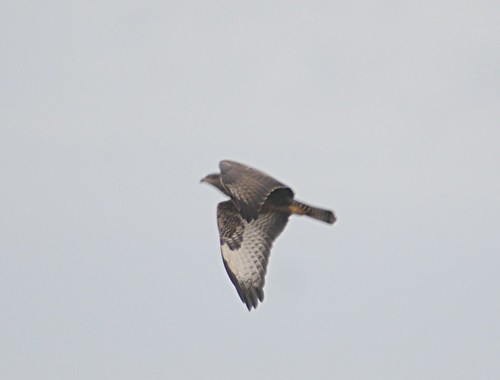
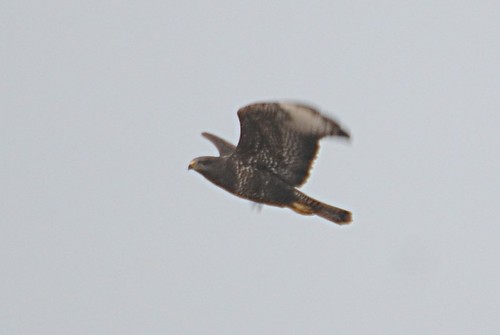
Time for more filthy record shots I'm afraid. I want to share pictures of as many of the species I've seen here as possible you see and sometimes things get ugly. Our field has just been resown with grass seed for next year's grazing and accordingly is generally full of gulls. On saturday afternoon though I pulled into the drive and saw nothing in the field. I was just pondering how odd that was when this guy popped up out of the dirt and flapped away.

buzzard1

It's a common buzzard (Buteo buteo - same genus as the American Red Tail Hawk and similar bird, american readers) and the gulls did not like its presence one bit - hence their absence and subsequent mobbing of it.

buzzard3

Ironically, the buzzard was probably not in the field hoping to feast on gull but in fact probably grubbing around for worms. This species has a diverse diet but tends to prefer carrion and invertebrate prey to bigger animals (though it can take much bigger stuff if so minded).

buzzard2

I grabbed my camera off the car seat and started shooting and the above are the heavily cropped awful result. Buzzards are rare here, a couple of breeding pairs on the island maybe (and those are recent arrivals) so it was a nice garden tick and a nice record to have.

Monday, November 01, 2010

River monster

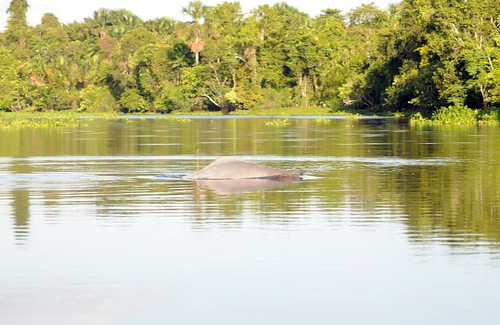
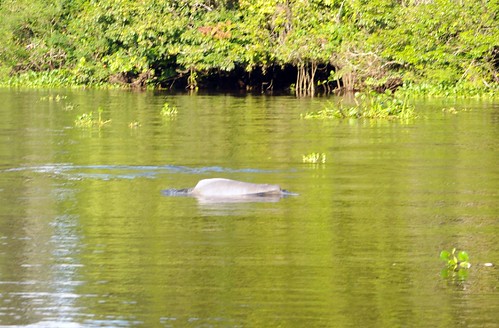
Travelling along a tropical river with toucans, parrots and monkeys flitting though the treetops either side of you is a magical experience and it can be easy as a result of this to overlook the water. That can be a mistake, things swim in tropical rivers. Surprising things......

boto1

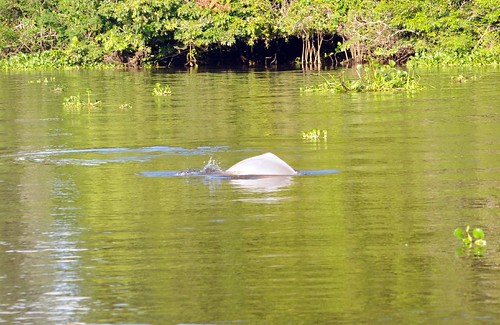
Yep. That is a freshwater dolphin. Specifically a Boto, Inia geoffrensis, the largest of the river dolphins.If we're gonna be really specific this is the Orinoco subspecies; humboldtiana.

boto3

Boto are weird. They're pink and pretty much blinf, they have extended rostrums as shown in the shot above, pretty well perfect for catching fish (cf gharials) and those rostrums are often goofily lopsided.

boto2

Its also the subject of some weird legends - supposedly they carry off the womenfolk and so forth. Well goofy looking and the subject of creepy legends they may be. But they're still dolphins and seeingwild dolphins always equates to a huge grin and a perfect memory.